To be presented at ICDAR 2026


UniLipi: A Unified Multi-Script OCR for Historical Indic Manuscripts

A single OCR foundation model trained jointly across 13 Indic scripts.

Tathagata Ghosh, Sai Madhusudan Gunda, Simran Singh Sandral, Ravi Kiran Sarvadevabhatla

International Institute of Information Technology, Hyderabad

tathagata.ghosh@research.iiit.ac.in  Β·  sai.gunda@research.iiit.ac.in  Β·  ssandral@gitam.in  Β·  ravi.kiran@iiit.ac.in

13Indic scripts
32.5MSynthetic lines
6.9%Overall CER
85MParameters
Abstract

Optical character recognition (OCR) for handwritten Indic manuscripts is essential for large-scale digitization and computational access to manuscript heritage. However, existing approaches are typically developed for one script at a time and require substantial script-specific customization. This limits scalability and practical deployment across diverse collections. We present UniLipi, a unified multi-script OCR model for handwritten Indic manuscripts trained jointly across 13 Indic scripts within a single framework. UniLipi directly handles realistic manuscript conditions, including extreme variation in line geometry, large variation in line length, and partial interruptions caused by non-textual manuscript entities such as holes, stains, or pictorial illustrations. To operate effectively under ultra low-resource conditions, the model leverages script-aware synthetic manuscript data generation, substantially reducing reliance on large volumes of real annotated data. Beyond historical manuscripts, we show that UniLipi serves as an effective foundational pretrained model β€” its learned representations enable strong OCR performance for contemporary Indic handwriting and extend to several non-Indic scripts including Tibetan, Italian, Latin, and Chinese. In addition to transcription, UniLipi predicts script identity and per-line native character counts, supporting practical manuscript cataloging workflows.

Diversity of Indic Manuscripts

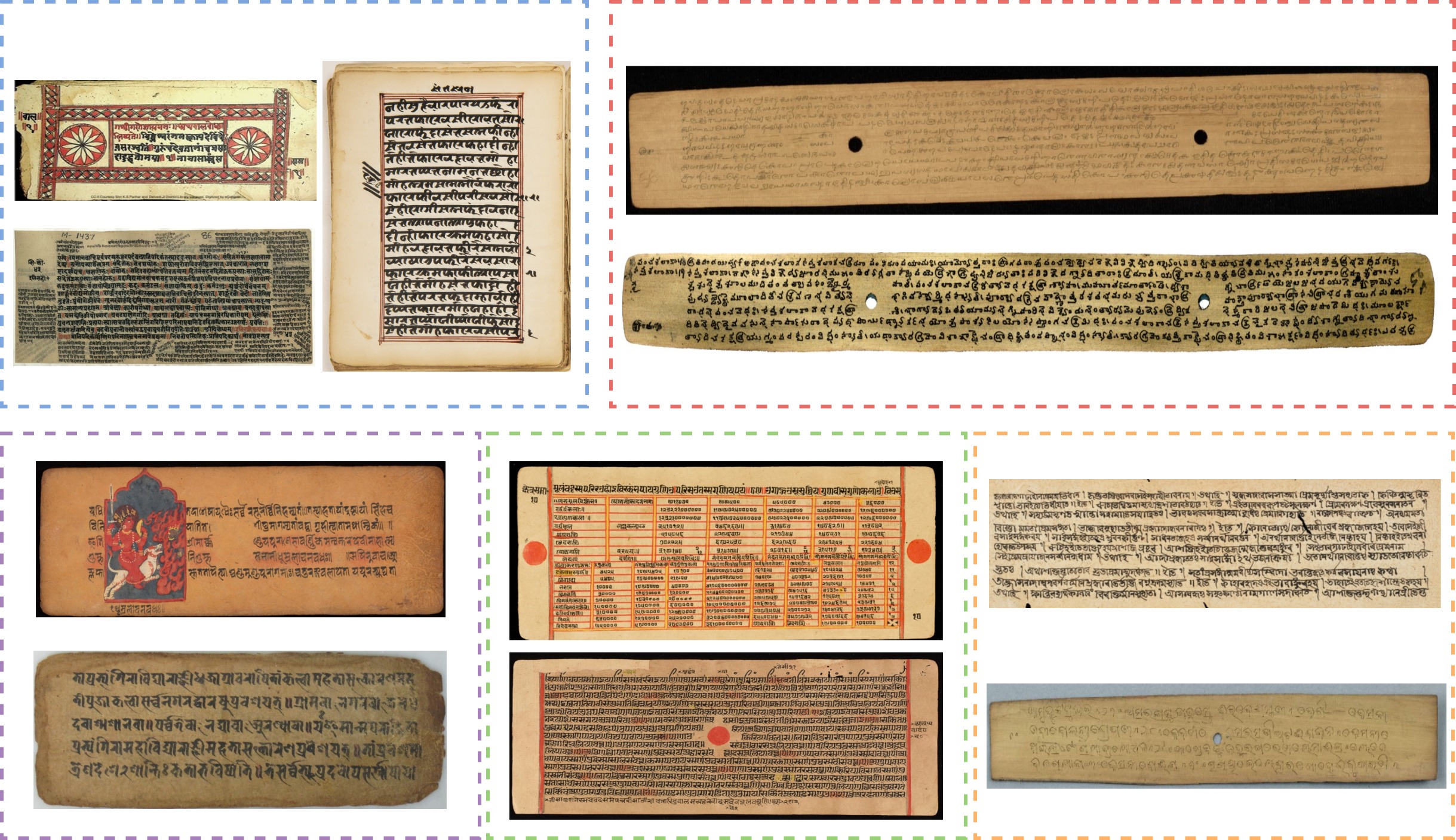
Indic manuscripts span centuries, regions, and writing substrates. UniLipi targets 13 scripts drawn from five regional traditions: North/Central Indian, Southern Indian, Himalayan/Buddhist, Western Indian, and Eastern Indian.

Diversity of manuscript styles across Indic script regions
Diversity of manuscript styles across Indic script regions. Examples of manuscript lines from multiple historical collections grouped by geographic and script traditions: North/Central Indian, Southern Indian, Himalayan/Buddhist, Western Indian, and Eastern Indian. The examples illustrate substantial diversity in writing substrates (palm leaf, paper), layout geometry, stroke thickness, ink characteristics, and orthographic structure across scripts and regions.

Contributions

Method

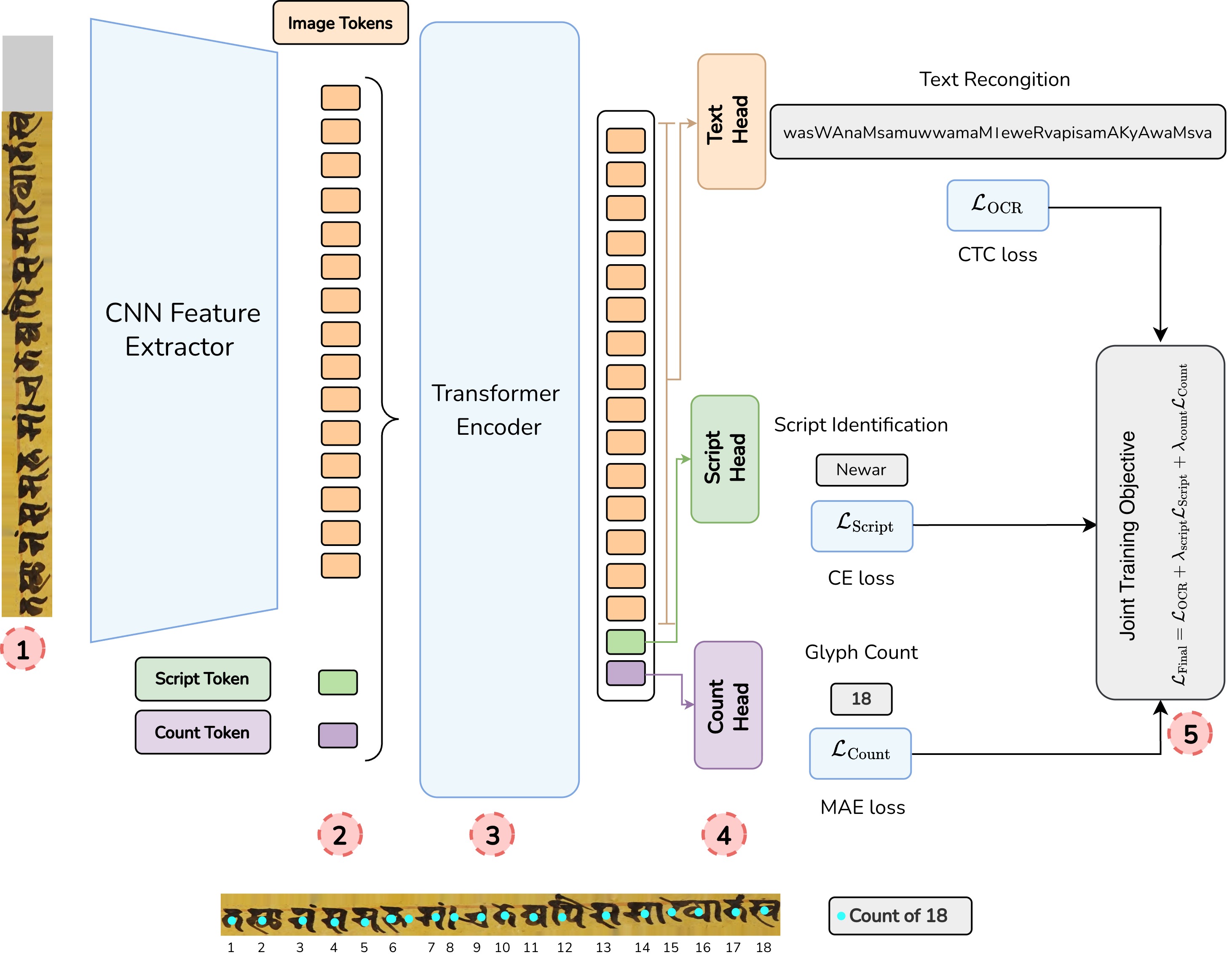
UniLipi is a unified multi-task OCR model. Given a manuscript line image, it jointly predicts a text sequence in the unified Roman WX representation, a script identity label, and a per-line glyph count. The architecture is a hybrid CNN–Transformer with task-specific heads.

UniLipi architecture overview
UniLipi architecture overview. A CNN backbone extracts a sequence of image tokens from a padded line image. A learnable script token and a count token are appended to the image-token sequence and encoded by a Transformer with windowed self-attention. Image-token representations are decoded by a CTC-based text head to produce a Roman WX transcription, while the latent task tokens feed dedicated heads for script identification and glyph-count prediction. Training uses a joint OCR + script + count objective.

Joint training objective

The model is trained end-to-end with a multi-task loss combining CTC for text recognition, cross-entropy for script classification, and mean absolute error for glyph count:

β„’ = β„’OCR  +  Ξ»script Β· β„’script  +  Ξ»count Β· β„’count

Joint supervision encourages the encoder to learn richer representations that capture textual content, script identity, and structural length information together β€” improving transcription accuracy across diverse manuscripts.

Reference-Conditioned Synthetic Data

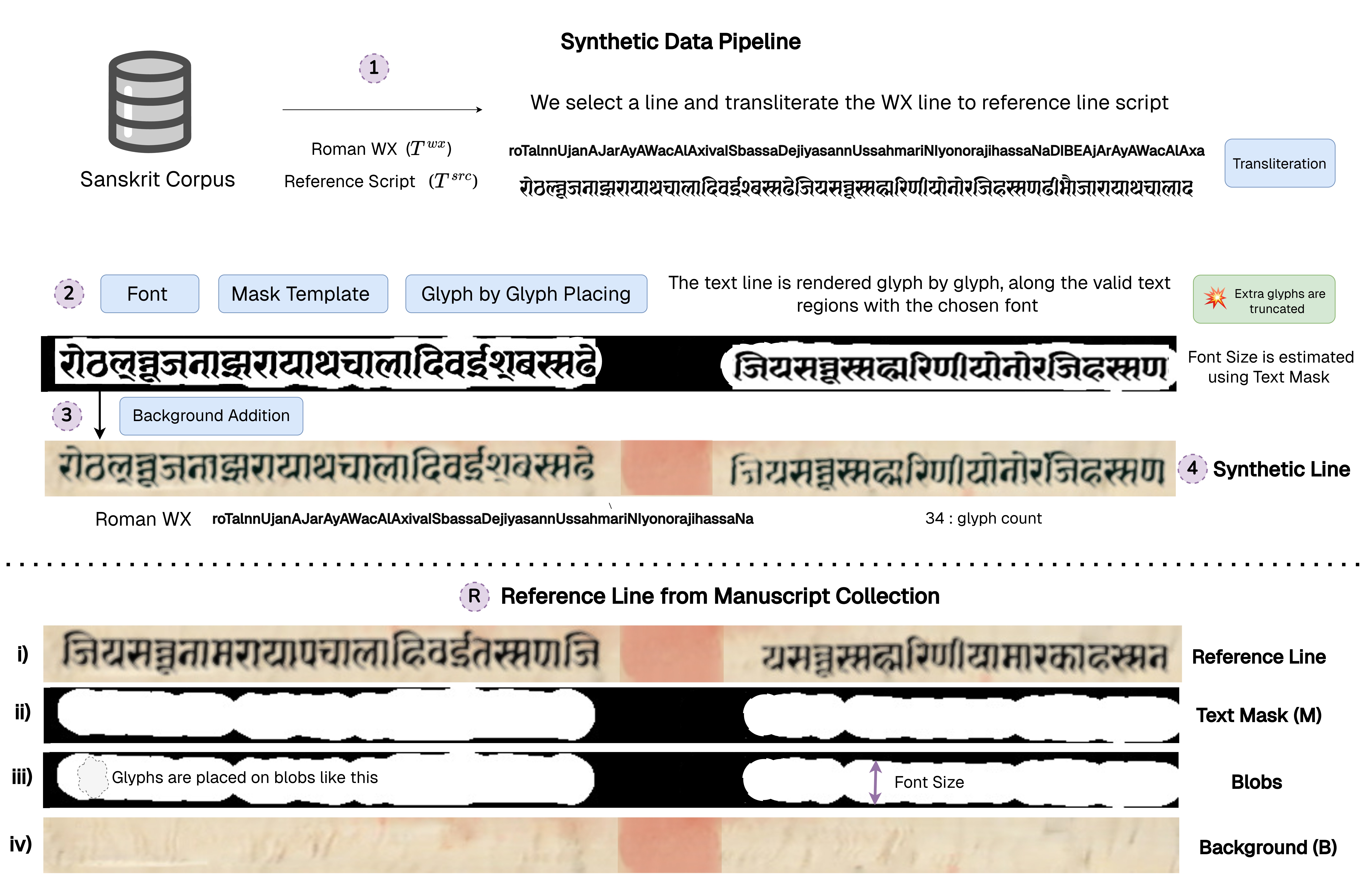
Real annotated manuscript lines are extremely scarce for many Indic scripts. We generate large-scale synthetic training lines by lifting appearance and geometric priors from real reference manuscripts β€” yielding roughly 2.5M synthetic lines per script and 32.5M total across the 13 scripts.

Reference-conditioned synthetic line generation pipeline
Reference-conditioned synthetic line generation. (1) Sample a Roman WX text line and transliterate it into the target script. (2) From a reference manuscript line, extract the writing mask, estimate font size and ink color, then render glyphs sequentially within valid regions using script-specific fonts. (3) Composite the rendered text onto a diffusion-inpainted clean background to preserve realistic manuscript characteristics. (4) Output the final synthetic line paired with its WX transcription, script label, and glyph-count supervision.

Results β€” Overall Scores

Overall (weighted) performance of UniLipi across all 13 Indic scripts. CER (%) for OCR transcription, Mono CER (%) for script-specific monolingual models, and Count-MAE for glyph count prediction.

Setting CER (%) ↓ Mono CER (%) ↓ Count-MAE ↓
UniLipi (Overall, weighted) 6.9 8.6 1.1

Across the 13 scripts, UniLipi attains an overall 6.9% CER, outperforming dedicated per-script (monolingual) models at 8.6% CER β€” demonstrating the benefit of unified multi-script training.

Qualitative Results

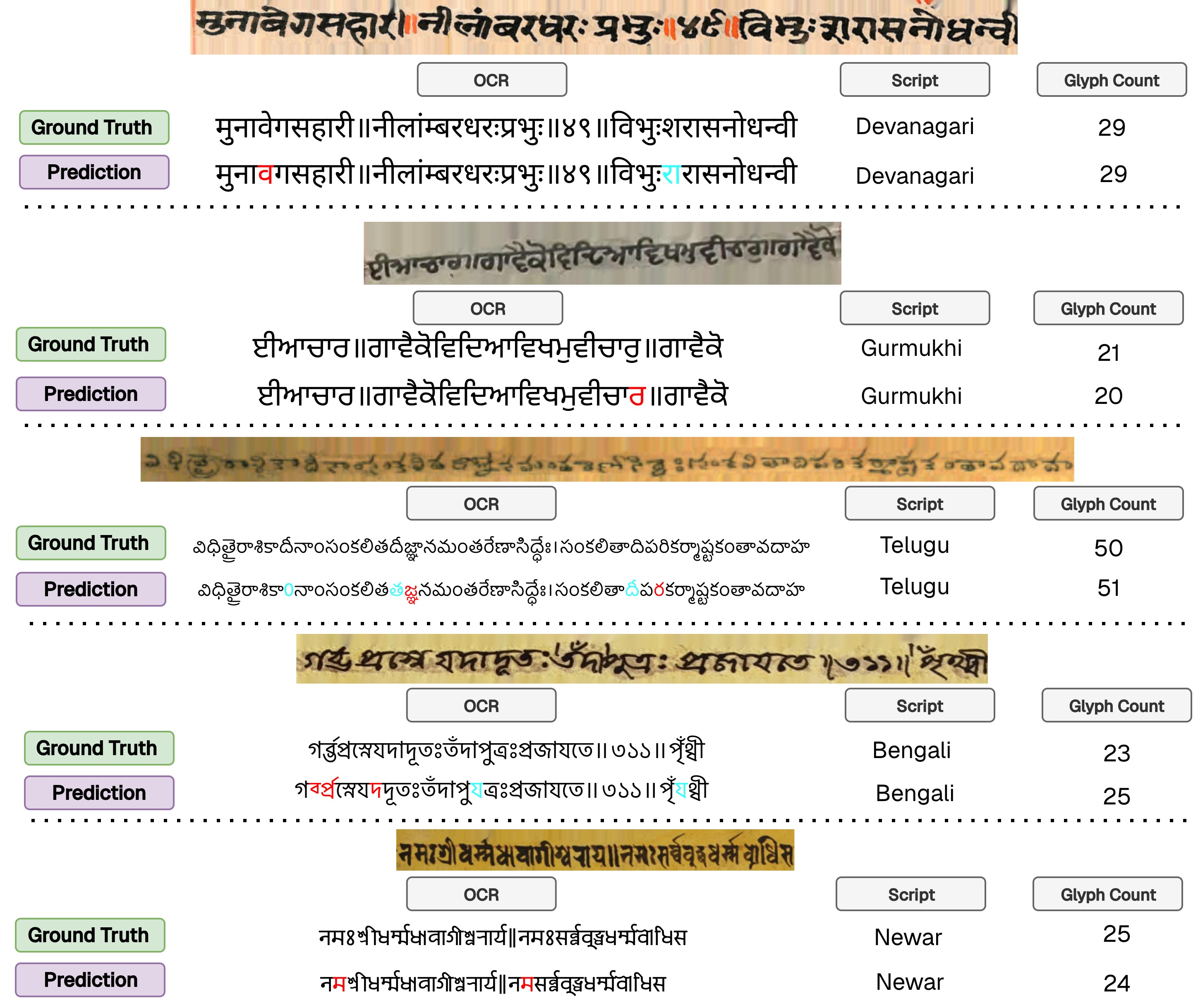
Qualitative OCR results across regions
Qualitative results of UniLipi on a representative script for each region. Red marks deletions; blue marks substitutions or additions.

Ablation Study

Ablation study of UniLipi. Each row modifies a single component while keeping all others identical; the final configuration is highlighted.

Modified component Default CER ↓ Count-MAE ↓
IAST as vocab Roman WX 11.01.7
Dedicated vocab per script Roman WX 14.11.9
No script token Auxiliary tokens7.1 1.3
No count token Auxiliary tokens9.3 β€”
No script & count tokenAuxiliary tokens9.7 β€”
Encoder with 4 layers 6 layers 9.3 1.5
Encoder with 8 layers 6 layers 8.1 1.3
β„’OCR as Cross-EntropyCTC loss 8.3 1.4
UniLipi (Final)Default design6.91.1

Count-Token Attention Heatmap

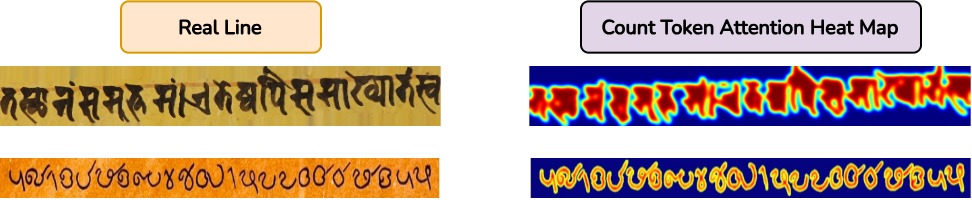
Count-token attention heatmap
Attention structure induced from the count token in UniLipi. The heatmap illustrates the model's ability to localize glyph-level structure, which serves both as auxiliary supervision and as a lightweight quality-control cue at inference time.